

|
🔍 Introduction: What This Book Is All About
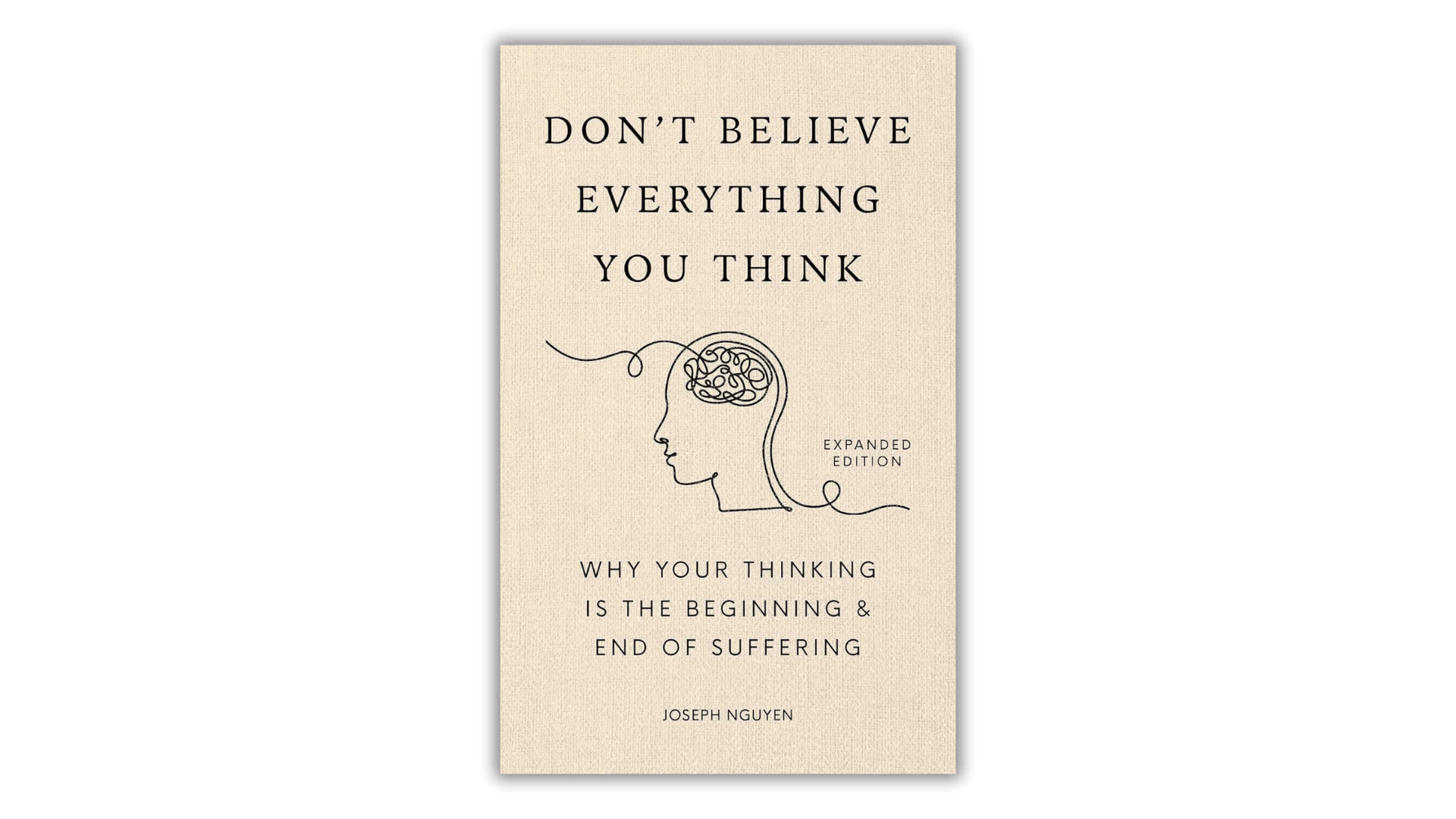
Don’t Believe Everything You Think presents a simple yet bold premise: much of our suffering arises from the way we engage with our thoughts rather than the external events of life itself. Through reflective prose, personal anecdotes, and philosophical pointers, Joseph Nguyen explores how habitual thinking — especially ruminative, fear-driven, or unexamined thought — acts as a barrier to peace, presence, and emotional freedom. The book aims to help readers distinguish between their innate state of being and the stories their minds create about the world.
At its core, this is a guide to understanding and disentangling from the relentless chatter of the mind — what Nguyen suggests is often the root cause of emotional distress, anxiety, and self-imposed suffering. The intended outcome is clarity, calm, and a deeper connection with the present moment rather than constant mental analysis.
🌿 Core Teachings and Major Themes
Although brief, this book touches on several recurring themes that many readers found either enlightening or controversial. The central thesis is that while thoughts themselves come and go, the way we engage with them — believing, resisting, or overthinking — largely shapes our experience of life. Nguyen urges readers to notice how thinking creates emotional reactions, then cultivate the ability to let thoughts pass without giving them unnecessary power.
1. Thinking vs. Thought: A Key Distinction
One of the book’s fundamental ideas is the difference between thinking (the process, often habitual and unconscious) and thoughts (the discrete mental events that arise and pass). Nguyen suggests that it is not thought itself that causes suffering, but the mental struggle to engage, resist, or cling to those thoughts. By understanding this distinction, readers can begin observing their minds more objectively and lessen mental turmoil.
2. Present-Moment Awareness
A major theme is the value of presence. Nguyen argues that the peace we seek is often obscured by endless thinking about the past or future. Moments when we are fully engaged in the present — such as in flow states, deep connection, or simple awareness — reveal a natural calm that lies beyond incessant internal dialogue. This emphasis aligns with mindfulness and contemplative traditions that view presence as a path to inner freedom.
3.Mindfulness of Suffering
Nguyen answers the question “Why do we suffer?” by reframing suffering as a byproduct of our beliefs about thoughts. Pain or difficult experiences are inevitable, but the narratives we attach to them — our interpretations, judgments, and mental overlays — create additional suffering. Breaking this pattern requires noticing when we’ve become lost in thinking and returning attention to direct experience instead.
4. Spiritual and Philosophical Dimensions
The book ventures into spiritual territory, suggesting that true wisdom and peace arise from recognizing a deeper inner state — sometimes framed as intuition, universal consciousness, or innate peace. For some readers, this spiritual dimension reinforces the message, offering comfort and depth. For others, this shift away from strictly psychological framing can feel vague or over-interpretive.
📖 Reader Experience: Strengths and Challenges
Reactions to Don’t Believe Everything You Think are notably mixed. Many readers praise its simplicity and practical viewpoint, especially those struggling with overthinking or high anxiety who are seeking a clear lens to view their internal experience. For these readers, Nguyen’s ideas about stepping back from thoughts and observing the mind without attachment have been genuinely transformative and calming.
However, other readers criticize the book for being too simplistic, poorly edited, or lacking depth. Some feel the core message could be condensed into a shorter essay or blog post, and that repetition without added insight weakens the overall impact. The writing style and anecdotal structure — sometimes leaning into spiritual metaphors or metaphysical claims — also divide opinion. Many reviews mention that while the book’s premise has value, the execution may not satisfy readers expecting rigorous psychological analysis or scientific grounding.
1. Strengths Noted by Readers
-
The book is easy to read and approachable, even for busy readers or beginners in personal growth.
-
Many found the core idea — learning to detach from unhelpful thinking — genuinely helpful in reducing anxiety and overthinking.
-
Some readers felt emotionally supported by the book’s emphasis on presence and innate peace rather than performance or achievement.
2. Common Criticisms
-
The writing style and tone are seen as immature or repetitive by some readers.
-
The message can feel overly simplistic or lacking in practical, detailed methods for application.
-
Certain spiritual or philosophical sections may feel vague or ungrounded for readers seeking concrete psychological framing.
-
Some reviewers wished for more scientific evidence or deeper exploration of the concepts discussed.
🛠️ What You Can Take Away
Despite divergent opinions, there are several clear takeaways from this short self-help book:
-
Thoughts are not facts: Recognizing that just because a thought arises doesn’t mean it must be believed or reacted to.
-
Observation over engagement: Learning to observe thoughts as they arise and pass can create emotional space and clarity.
-
Presence matters: Connecting with the present moment, rather than constant internal dialogue, can shift emotional experience.
-
Understanding suffering: The book invites readers to rethink suffering not as an external inevitability but as something largely amplified by how we relate to our minds.
🎯 Who This Book Is For
This book will likely resonate most with readers who:
-
Feel overwhelmed by their thoughts and seek a simple reframe.
-
Are open to a blend of philosophical, spiritual, and psychological ideas.
-
Want a short, digestible read that prompts reflection rather than technical instruction.
-
Are new to mindfulness or self-awareness practices and want an accessible introduction.
Conversely, readers looking for a deeply scientific or psychologically rigorous approach to thought patterns and mental health may find this book lacking in structure and evidence.
⭐️ Final Thoughts: A Thought-Provoking, if Uneven, Self-Help Read
Don’t Believe Everything You Think is a compact but thought-provoking exploration of the relationship between thought and suffering. Its greatest strength lies in its simplicity — a reminder that often the peace we seek is obscured by habitual thinking rather than absence of external challenges. For many, this can be a powerful and clarifying insight that sparks changes in how they relate to their internal experience.
At the same time, the book’s brevity, repetitive nature, and occasional spiritual or vague language mean it won’t satisfy every reader. Whether you embrace its core idea as a life-changing perspective or see it as an interesting philosophical nugget, this book can serve as a catalyst for deeper reflection on your own relationship with thought — and how you choose to let it shape your life.